

If you’re new to goth gardening and don’t know where to begin, I strongly suggest starting with a pothos plant. There are 65 species in the Pothos genus, but the pothos plants I’m referring to are not on the list, because technically they are not Pothos. They’ve staked their claim to the name, though, and there’s no sign that’s going to change anytime soon.
A code of play,
Bauhaus (Lagartija Nick)
A nocturn rite,
In the cruel garden of dark delights.
Sixteen cages crawl in line.
Desire is a heady wine.
Table of Contents
A Tale of Two Pothos Plants
Epipremnum aureum and Scindapsus pictus are the botanical classifications for two common “pothos” houseplants that bear a striking resemblance to one another and are both toxic to dogs, cats, and horses if consumed. However, upon closer inspection, there are distinct differences.
Epipremnum aureum
Commonly sold as Golden Pothos, Marble Pothos, Taro Vine, and Devil’s Ivy, Epipremnum aureum has waxy, smooth leaves with gold, white, or pale green striations. It can grow to heights up to 65 feet and typically has green stems.

This “pothos” is very hardy and will stay green even when kept in the dark, which earned it its “Devil’s Ivy” moniker. Such an odd and unusual thing must, after all, be the work of the devil, by some superstitious standards.
From 1880 to 1962, Epipremnum aureum was misclassified as Pothos aureus, and even though it’s been reclassified 3 times, the original “pothos” misnomer has stuck. It’s sort of the Emo of goth subculture – it started there, but it’s not the same thing, yet people still call Emo folks Goths. It’s all very complicated and confusing.


Scindapsus pictus
The matte-textured, silver-gray Scindapsus pictus typically reaches no more than 10 feet in height and sometimes has variegated stems with striations of gold or white. Scindapsus pictus has thicker foliage than Epipremnum aureum, which appears to shimmer when touched by sunlight.

Scindapsus pictus is commonly known as Satin Pothos, Silver Pothos, and Silver Vine. Popular variants of this “pothos” include Silver Satin, Silver Splash, Silvery Anne, and Jade Satin.


Why Pothos?
To begin with, these plants are very easy to care for, so your chance of success with either of them is extremely high. Even in the worst of circumstances, these pothos seem to always persevere. They aren’t invulnerable, but if you manage to kill one, you likely did so intentionally, drowned the poor creature, or forgot you owned one altogether, and in any of those cases, I can confidently say that gardening is just not for you.
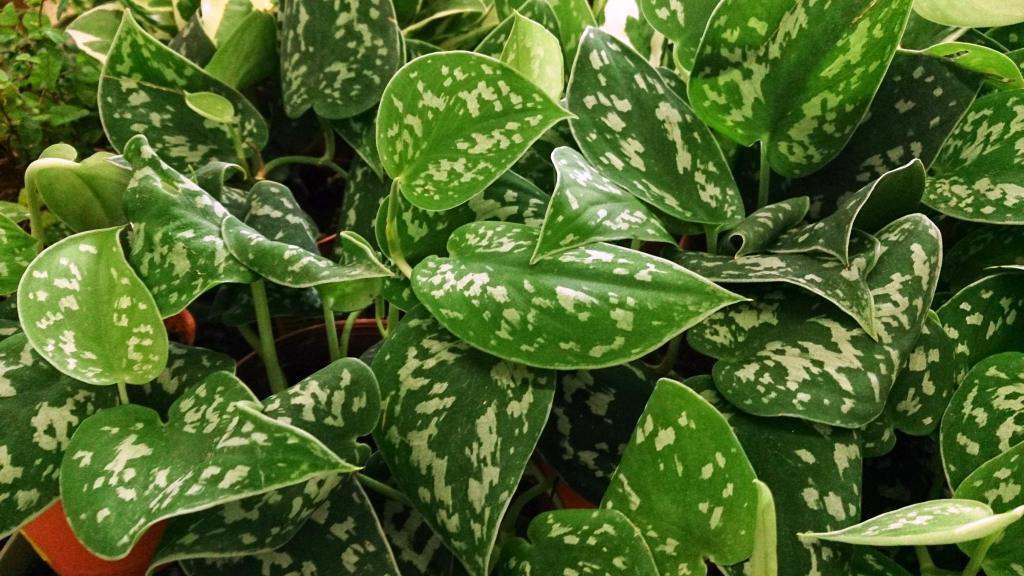
Pothos is a shade plant, which means it’s comfortable growing in low light levels. The plants will need some light (note that shade does not mean total absence of light) in order to grow, but it doesn’t need to be set in a window or even within a few feet from one.
You’ll see faster growth by a full-spectrum grow light or placing the plants in brighter, indirect sunlight, but most any light will give them what they need for basic survival. In other words, they are extremely goth-friendly.


Both Epipremnum aureum and Scindapsus pictus can tolerate bone-dry potting soil for quite some time, should you forget to water them. As with most plants, it’s over-watering that will do more damage. I’ve seen droopy, wilted pothos plants (Not mine. I would never!) that were neglected for weeks spring back when they finally got a much-needed drink.
Both of these pothos plants prefer temperatures between 70-90 ºF, monthly fertilizing during spring and summer, and have no special soil requirements. Any pH-neutral potting mix will be adequate, with some perlite or vermiculite mixed in to assist with drainage.
If you live in USDA Hardiness Zones 10 through 12, Epipremnum aureum and Scindapsus pictus will thrive outdoors.
These plants grow quickly in ideal conditions and will reward you with long, dramatic vines that can be suspended from hanging planters, trained up walls and over arches, or attached along any firm surface like trees, walls, bricks, and fences to create an incomparable spectacle.


Source book page: https://archive.org/stream/windowgarden00will/windowgarden00will#page/n285/mode/1up, No restrictions, https://commons.wikimedia.org/w/index.php?curid=43901120
Pothos in Myth, Art, and Literature
In Greek mythology, Pothos is one of the seven Erotes, eternally youthful, winged gods, and the son of the love goddess Aphrodite and Ares, the god of war. Like his brothers Eros and Himeros, Pothos is an embodiment of desire, specifically the longing and yearning that one has for an absent lover. He is often depicted holding a torch as if searching for something lost or unattainable, symbolizing the desire for human connection and the lust for sexual fulfillment.

In ancient Greece, Asphodelus albus, the white asphodel flower, was sometimes called pothos. It was not associated with desire, but with mourning. White asphodel is renowned as the flower that blankets the Asphodel Meadows of the Underworld, “where dwell the spirits and shadows of them that can labor no more” (Homer, Odyssey 24.11-14).
Pothos’ association with tragic circumstances, death, and forbidden love aligns perfectly with the mysterious and romantic aesthetic favored by many in the goth subculture, making it a fitting representation for those drawn to the darker and more introspective aspects of life. Its ability to thrive in low light and its resilient nature can be seen as a metaphor for finding beauty and strength in unexpected or challenging circumstances, adding to its allure for those who appreciate symbolic significance.

